Frozen Shoulder Recovery — How Acupuncture and Rehabilitation Work Together
Frozen Shoulder Recovery
How Acupuncture and Rehabilitation Work Together
Frozen shoulder can turn simple movements into daily challenges.
Reaching for a shelf, putting on a jacket, fastening a bra, sleeping on your side, or lifting your arm overhead may become increasingly painful and difficult. Over time, the shoulder can become progressively stiffer, limiting both everyday activities and physical performance.
Known medically as adhesive capsulitis, frozen shoulder is a condition characterized by shoulder pain and significant loss of movement.
For many patients, recovery requires more than simply managing pain. The shoulder also needs to gradually regain mobility, strength, coordination, and function.
This is where acupuncture and rehabilitation can work together.
Rather than viewing Traditional Chinese Medicine and modern rehabilitation as competing approaches, an integrated treatment strategy can use each approach for the role it is best suited to support:
Acupuncture and TCM → symptom and pain management
Rehabilitation → mobility, strength and functional recovery
The right combination depends on the individual's condition, symptoms, medical history, and recovery goals.
What Is Frozen Shoulder?
Frozen shoulder, or adhesive capsulitis, occurs when the tissues surrounding the shoulder joint become painful and progressively restrict movement.
Patients commonly experience:
Shoulder pain
Progressive stiffness
Reduced range of motion
Difficulty reaching overhead
Difficulty reaching behind the back
Pain or difficulty sleeping
Limitations in work, exercise, and daily activities
Frozen shoulder is often described using three phases:
Freezing → Frozen → Thawing
However, these phases do not follow exactly the same timeline for everyone. The duration and severity of symptoms can vary considerably.
For this reason, effective treatment should focus on the patient's actual pain, range of motion, strength, and functional limitations, rather than relying solely on a stage label.
Stage 1 — Freezing
The Painful Stage
During the early phase, pain is often the dominant problem.
The shoulder may become increasingly painful, particularly at night or during movements such as reaching, lifting, or rotating the arm. As pain increases, people often begin moving the shoulder less, which can contribute to further stiffness.
Where acupuncture may help
Acupuncture may be used as part of a broader pain-management strategy.
For appropriately selected patients, acupuncture may help with:
Pain reduction
Muscle tension
Symptom management
Sleep disruption associated with pain
Tolerance of movement and rehabilitation
The purpose is not simply to temporarily reduce discomfort. By helping manage symptoms, acupuncture may make it easier for the patient to participate in appropriate movement and rehabilitation.
Where rehabilitation fits
Rehabilitation during this phase is generally focused on maintaining comfortable movement rather than aggressively forcing the shoulder.
Depending on the patient's condition, treatment may include:
Gentle range-of-motion exercises
Movement education
Postural awareness
Appropriate mobility exercises
Strategies to avoid aggravating movements
The goal
Manage pain while maintaining as much comfortable mobility as possible.
Stage 2 — Frozen
The Stiffness Stage
As the condition progresses, pain may become less dominant while stiffness becomes increasingly significant.
Patients may notice difficulty with:
Raising the arm overhead
Reaching behind the back
Putting on clothing
Reaching across the body
Performing household activities
Returning to exercise or sport
This is often the point at which rehabilitation becomes increasingly important.
Acupuncture as an adjunct
Acupuncture may continue to be used to help manage residual pain or muscle tension.
However, acupuncture should not be considered a substitute for rehabilitation when restoring movement and function is the primary goal.
Rehabilitation takes the lead
A progressive rehabilitation program may incorporate:
Active and passive range-of-motion exercises
Mobility training
Stretching
Joint mobilization where appropriate
Scapular control
Postural training
Progressive strengthening
Functional movement exercises
The intensity and progression should be adjusted according to the patient's symptoms and response.
The goal
Restore range of motion, reduce stiffness, and rebuild functional movement.
Stage 3 — Thawing
The Recovery Stage
During the recovery phase, shoulder movement gradually improves.
Pain may continue to decrease, but some patients still experience:
Weakness
Reduced endurance
Limited movement
Poor movement coordination
Difficulty returning to previous activities
At this stage, rehabilitation increasingly focuses on rebuilding capacity.
Progressive rehabilitation
Treatment may progress toward:
Mobility → Strength → Movement control → Functional activity → Return to sport
Exercises can be gradually adapted to the patient's lifestyle and goals.
For someone who simply wants to return to normal daily activities, the rehabilitation program may focus on everyday movement.
For an athlete, the program may eventually include sport-specific strength, coordination, loading, and return-to-play progression.
What about acupuncture?
Acupuncture may still be useful for some patients experiencing residual pain or muscle tension, but its role may become less central as functional rehabilitation becomes the primary focus.
The goal
Restore movement, strength, confidence, and function.
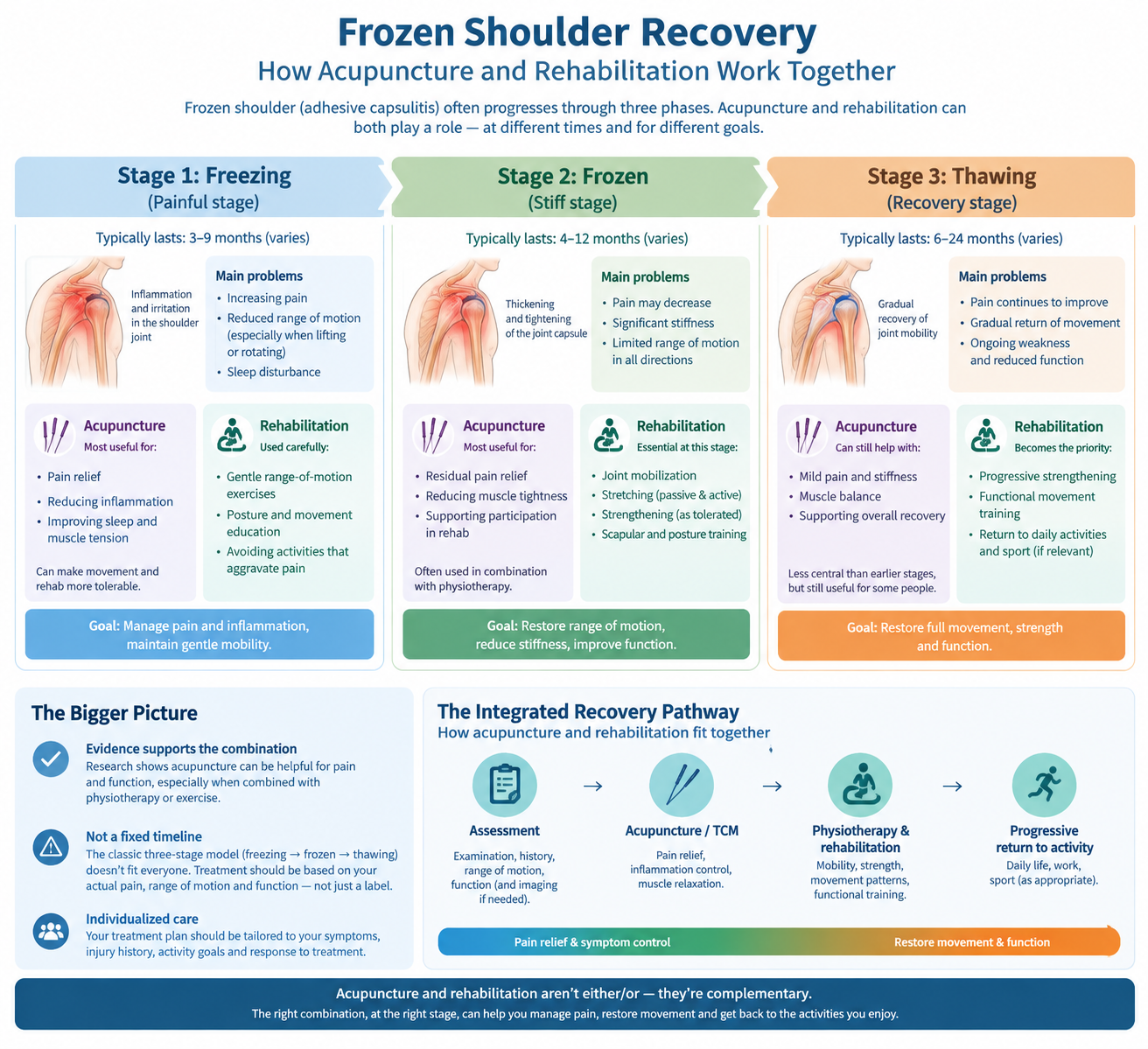
Why Combine Acupuncture With Rehabilitation?
The strength of an integrated approach is that the two methods can address different dimensions of recovery.
Acupuncture and TCM
May support:
Pain management
↓
Muscle relaxation
↓
Improved tolerance of movement
Rehabilitation
Targets:
Mobility
↓
Strength
↓
Movement control
↓
Functional recovery
This creates a broader treatment pathway:
Assessment
Understand the condition, symptoms, movement limitations, and goals.
↓
Acupuncture / TCM
Address pain and other symptoms when clinically appropriate.
↓
Rehabilitation
Progress mobility, strength, and movement according to the patient's condition.
↓
Functional Recovery
Gradually return to normal activities, exercise, work, or sport.
What Does the Evidence Say?
The evidence surrounding acupuncture for frozen shoulder is promising but should be interpreted carefully.
Systematic reviews have reported improvements in pain and shoulder function following acupuncture treatment, although the quality and certainty of the evidence vary between studies.
More importantly, research has also investigated acupuncture combined with physical therapy.
A 2024 systematic review and meta-analysis found that combining acupuncture with physical therapy was associated with improvements in pain, clinical outcomes, and active and passive shoulder range of motion compared with physical therapy alone.
This does not mean that acupuncture is a standalone cure for frozen shoulder.
Instead, the evidence supports a more measured interpretation:
Acupuncture may be a useful complementary treatment within a broader rehabilitation program for appropriately selected patients.
Rehabilitation remains particularly important when the primary limitations are restricted movement, weakness, and loss of physical function.
A Modern Integrated Approach to Frozen Shoulder
At Shan Clinic, this type of integrated thinking reflects the broader approach of combining Traditional Chinese Medicine with modern medical assessment and rehabilitation principles.
The clinic's current medical team includes practitioners specializing in acupuncture, rehabilitation medicine, pain management, musculoskeletal disorders, sports injury rehabilitation, and integrative Chinese and Western medicine.
For example, Dr. Zhao's clinical approach combines traditional Chinese therapeutic techniques with modern musculoskeletal assessment and functional rehabilitation, while Dr. Qiu specializes in acupuncture, rehabilitation medicine, pain management, and integrative Chinese medicine.
This type of approach can be particularly relevant when a patient's goal is not simply “less pain”, but better movement and restored function.
From Pain Relief to Functional Recovery
One of the biggest mistakes in treating musculoskeletal conditions is to define success only by whether the pain has decreased.
Pain relief matters.
But so does the ability to:
Raise your arm
Reach behind your back
Sleep comfortably
Work without restriction
Exercise safely
Return to your sport
Perform everyday activities with confidence
That is why an integrated recovery plan should consider both symptoms and function.
Pain relief is part of recovery.
Restoring movement is part of recovery.
Rebuilding strength is part of recovery.
Returning to life is the ultimate goal.
Acupuncture and Rehabilitation Are Complementary
You do not necessarily have to choose between acupuncture and rehabilitation.
For an appropriately assessed patient, they can form complementary components of a broader treatment plan:
Acupuncture / TCM
Support symptom and pain management
Rehabilitation
Restore mobility, strength, movement, and function
Integrated care
Connect the two according to the patient's condition and recovery goals
The ideal treatment is not necessarily the treatment with the most techniques.
It is the treatment that uses the right approach, at the right time, for the right patient.
When Should You Seek an Assessment?
If shoulder pain persists, progressively worsens, or significantly limits movement, a proper medical assessment is important.
Not every painful or stiff shoulder is frozen shoulder. Other conditions—including rotator cuff problems, arthritis, bursitis, tendon injuries, or referred pain—can produce similar symptoms.
An appropriate assessment helps determine the likely cause and whether acupuncture, rehabilitation, other treatment options, or further investigation may be appropriate.
Your recovery should be measured by more than pain.
The goal is to move better, function better, and get back to the activities that matter to you.
Shan Clinic
Integrated TCM & Rehabilitation Care in Shenzhen
Combining Traditional Chinese Medicine, acupuncture, pain management, musculoskeletal care, and rehabilitation to support individualized recovery.




