Why Does Frozen Shoulder Hurt More at Night?
Why Does Frozen Shoulder Hurt More at Night?
Understanding the causes of nighttime pain and what it means for recovery
If you have frozen shoulder, one of the most frustrating symptoms may be that your shoulder hurts more at night.
You may fall asleep relatively comfortably but wake several times because of aching or sharp pain. Turning over in bed can become difficult, and even finding a comfortable sleeping position may seem almost impossible.
This is not unusual.
Nighttime pain is a common feature of frozen shoulder, also known as adhesive capsulitis, particularly during the earlier, more painful stage of the condition.
But why does the shoulder often feel worse at night?
At Shan Clinic, we look at frozen shoulder from both a pain-management and functional-recovery perspective. Understanding why nighttime pain occurs can help patients better understand their condition and make more informed decisions about treatment and rehabilitation.
What Is Frozen Shoulder?
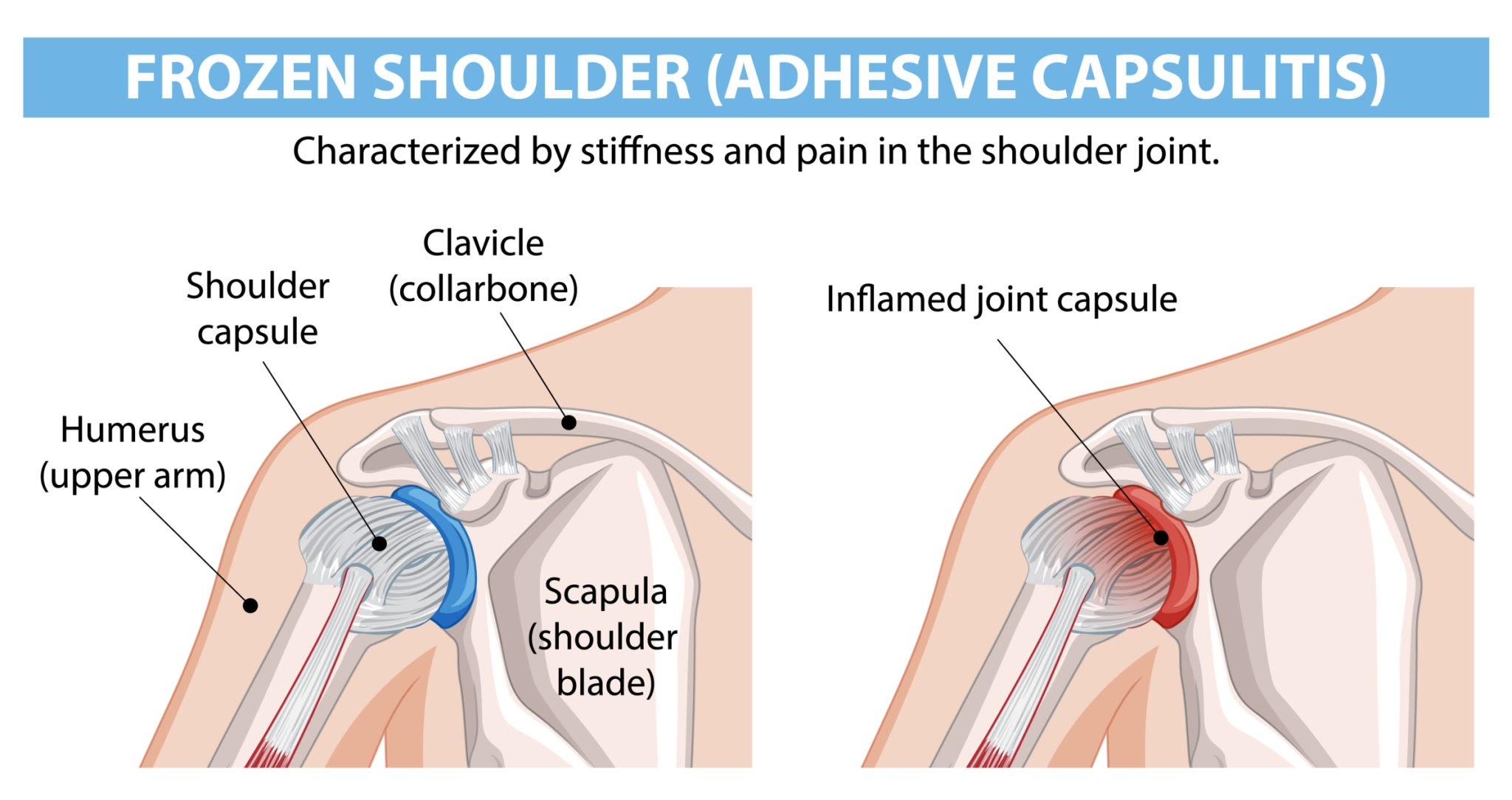
Inflammation and capsule thickening in adhesive capsulitis. Ref.:colematt / Getty Images
Frozen shoulder occurs when the tissues surrounding the shoulder joint become inflamed and progressively contract.
As the joint capsule becomes less flexible, the shoulder gradually loses its normal range of motion. Simple movements such as reaching overhead, putting on a jacket, fastening clothing, or reaching behind your back can become increasingly difficult.
Frozen shoulder generally develops through three overlapping phases:
1. Freezing Stage
Pain gradually increases, often accompanied by worsening shoulder stiffness.
Nighttime pain can be particularly significant during this stage.
2. Frozen Stage
Pain may begin to decrease, but stiffness and restricted movement can become more pronounced.
3. Thawing Stage
Shoulder mobility gradually improves as the joint becomes less restricted.
The duration and severity of each stage vary between individuals. Recovery is not always a straight line.
Why Does Frozen Shoulder Hurt More at Night?
There is no single explanation. Several factors can contribute to nighttime shoulder pain.
1. The Shoulder Remains Still for a Long Period
During the day, your shoulder is constantly making small movements.
At night, however, you may remain in one position for several hours.
A stiff shoulder can become increasingly uncomfortable when it remains still for an extended period. When you eventually move the arm, the joint may feel particularly stiff or painful.
This is one reason why some people notice significant discomfort when they first wake up.
2. Your Sleeping Position Can Put Stress on the Shoulder
Sleeping directly on the affected shoulder can place pressure on already sensitive tissues.
But sleeping on the opposite side does not necessarily solve the problem.
The affected arm may fall forward, backward, or into a position that places tension on the restricted shoulder capsule.
For someone with frozen shoulder, a position that would normally be harmless can therefore become uncomfortable or painful.
3. The Joint Capsule Has Become Tight
Frozen shoulder is more than simply a "tight muscle."
The capsule surrounding the shoulder joint can become thickened and contracted.
As a result, certain positions place tension on the capsule and surrounding tissues.
For example, moving the arm:
overhead
away from the body
outward
behind the back
may produce pain because the shoulder cannot move through its normal range.
This is why you can sometimes experience pain even when you are not actively using the shoulder.
4. Inflammation Can Increase Pain Sensitivity
During the painful stage of frozen shoulder, inflammation within and around the joint can contribute to pain.
At night, prolonged positioning and reduced movement may make these symptoms more noticeable.
It is important to understand that this does not necessarily mean the inflammation suddenly becomes worse after dark.
Rather, the combination of inflammation, restricted movement, and sustained positioning can make the shoulder feel more painful at night.
5. Pain Becomes More Noticeable When You Are Trying to Sleep
Pain is not determined only by what is happening inside the shoulder.
The nervous system also influences how pain is experienced.
During the day, work, conversation, movement, and other activities provide constant stimulation and distraction.
At night, the environment becomes quiet.
Your attention naturally turns toward your body, making the aching shoulder much more noticeable.
This does not mean that nighttime pain is psychological or "just in your head."
The physical problem is real. However, attention, stress, fatigue, and sleep quality can influence how strongly pain is perceived.
Why Poor Sleep Can Make the Problem Feel Worse
Nighttime shoulder pain can create a difficult cycle:
Shoulder pain
↓
Difficulty finding a comfortable sleeping position
↓
Interrupted sleep
↓
Fatigue and increased sensitivity to pain
↓
Greater difficulty coping with shoulder symptoms
Repeated sleep disruption can affect daytime energy, concentration, mood, and physical activity.
For this reason, managing nighttime pain should be considered part of the overall recovery process—not simply a matter of making sleep more comfortable.
How Can You Sleep More Comfortably With Frozen Shoulder?
There is no single sleeping position that works for everyone. However, several strategies may reduce unnecessary pressure on the shoulder.
Sleep on your back
For some people, sleeping on the back reduces direct pressure on the affected shoulder.
A pillow supporting the affected arm or elbow may help keep the shoulder in a more comfortable position.
Sleep on the unaffected side
If you prefer side sleeping, try lying on the non-painful side while supporting the affected arm with a pillow.
The purpose is to prevent the arm from falling forward or backward and placing unnecessary tension on the shoulder.
Avoid forcing a painful position
A common misconception is that the shoulder should be aggressively stretched whenever it feels stiff.
This is not necessarily appropriate.
During a painful stage of frozen shoulder, excessive stretching may irritate the tissues and increase discomfort.
The objective is controlled, progressive movement—not forcing the shoulder beyond its current tolerance.
Should You Exercise Before Going to Bed?
Gentle movement may help some people reduce stiffness before sleeping.
However, the appropriate exercise depends on the individual's:
stage of frozen shoulder
range of motion
pain level
tissue sensitivity
functional limitations
An exercise that is appropriate for someone in the recovery stage may be poorly tolerated by someone experiencing significant acute pain.
For this reason, frozen shoulder rehabilitation should be progressive and individualized rather than based on a single set of exercises for everyone.
Where Do Acupuncture and Rehabilitation Fit In?
Frozen shoulder treatment is not simply about reducing pain.
A comprehensive approach may need to address both symptoms and shoulder function.
Acupuncture for Pain Management
Acupuncture may be incorporated into a treatment plan to help manage pain and improve tolerance for movement.
For some patients, reducing pain can make it easier to participate in rehabilitation.
Rehabilitation for Mobility and Function
Rehabilitation focuses on gradually restoring:
shoulder range of motion
joint mobility
muscular function
movement patterns
everyday activities
The goal is not simply to make the shoulder feel better temporarily, but to progressively restore useful movement and function.
An Integrated Approach
At Shan Clinic, treatment decisions begin with an assessment of the individual's symptoms and functional limitations.
Depending on the patient's condition, acupuncture, manual therapy, therapeutic exercise, and other rehabilitation strategies may be incorporated into an individualized treatment plan.
Pain management and rehabilitation can work together: controlling symptoms may make movement easier, while progressive rehabilitation helps restore mobility and function.
When Should You Have Your Shoulder Assessed?
Although nighttime shoulder pain is common in frozen shoulder, not every painful shoulder is frozen shoulder.
Shoulder pain may also be associated with rotator cuff problems, bursitis, osteoarthritis, cervical spine disorders, nerve-related conditions, previous injury, or other causes.
Consider having your shoulder assessed if:
pain persists or continues to worsen
your shoulder movement is progressively decreasing
shoulder pain regularly disrupts your sleep
you experience significant weakness
symptoms began after an injury
you have numbness or tingling
you are uncertain about the cause of your symptoms
An appropriate assessment can help identify the likely cause of your shoulder symptoms and determine whether rehabilitation, pain management, or further medical evaluation is appropriate.
The Shan Clinic Perspective
Frozen shoulder recovery is rarely about treating one symptom in isolation.
Pain, stiffness, mobility, sleep, and daily function are interconnected.
Nighttime pain may be one of the first symptoms that makes patients realize something is wrong, but successful management should look beyond the nighttime discomfort itself.
At Shan Clinic, we emphasize individual assessment and a structured approach to recovery. By understanding the condition, identifying the factors contributing to pain and restricted movement, and developing an appropriate treatment and rehabilitation strategy, patients can work toward restoring shoulder function and returning to everyday activities.
Key Takeaway
Frozen shoulder can hurt more at night because of prolonged immobility, sleeping position, tension on a contracted joint capsule, inflammation, and increased awareness of pain when the body is at rest.
Nighttime pain is common, particularly during the painful stage, but persistent or severe symptoms should not simply be ignored.
The right approach is not necessarily to stretch harder or tolerate more pain.
It is to understand the condition, assess the shoulder accurately, manage pain appropriately, and progressively restore movement and function.
This article is intended for general health education and does not replace an individual medical assessment or diagnosis.




